


2025年全年以及2026年初,兩岸關係中最有趣的辯證趨勢是:中國大陸分別於2025年4月初和12月底舉行軍演,而大陸負責台灣事務的官員則表態溫和,目的是要達到恩威並施的效果。
2025年4月1至2日進行的「海峽雷霆」演習似乎旨在展示中國軍方如何打擊台灣的政治核心地帶、重要港口和能源供應基地。同年12月29至30日進行的「正義使命」演習則轉向空中和海上封鎖台灣島的能力。
然而,在這兩次軍事演習期間,中國官員就對台政策都發表了招安式的重要演說。
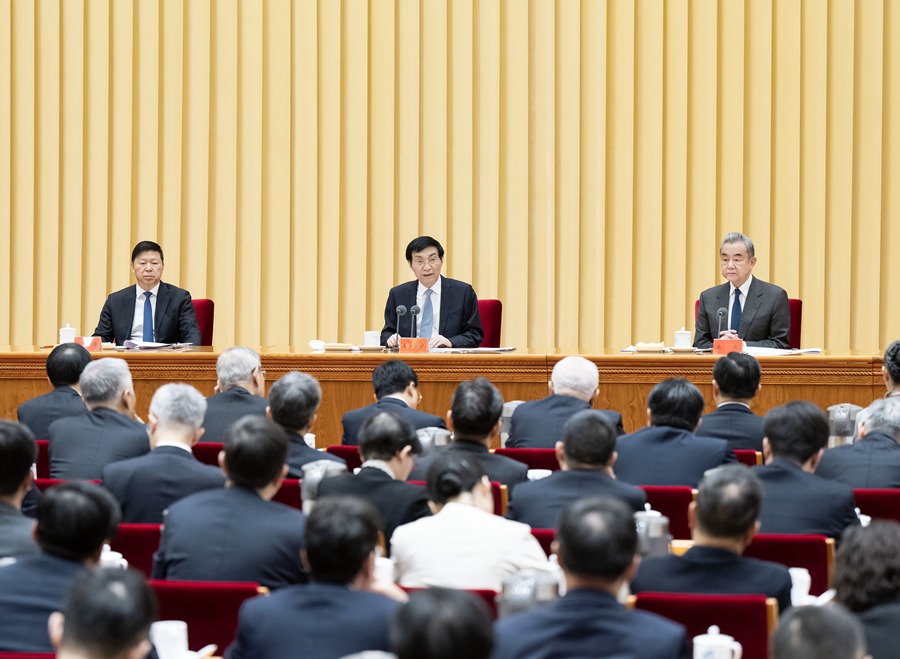
王滬寧:兩岸統一對台帶來七小福
中共中央政治局常委、全國政協主席王滬寧在2025年10月表示,兩岸統一將有「七大好處」:台灣將發展經濟;能源資源將得到保護;基本設施和結構將得到保留;安全將得到維護;對外關係將得到容忍;台灣同志的生計和福祉將得到保障;台灣人民的精神和文化生活將得到豐富。
溫和的言論,輔以強硬的姿態,反映大陸對台採取了恩威並施的策略:一方面強調和平統一可為台灣帶來巨大的利益,另一方面則展示中方在必要時有收復台灣島的軍事實力。
這項雙管齊下的策略,在國民黨台北市長蔣萬安訪問上海參加雙城論壇的第二天就顯露無遺。中國在這時機對外傳遞了一個重要的政治訊息:儘管國民黨過去是、現在仍然是大陸統戰和友好政策的目標,但強硬的軍事姿態則針對台灣島內有台獨傾向的分離主義領導人。
國民黨中共智庫論壇側重於關注低政治議題,包括災害管理、氣候變遷和能源發展等議題。台灣方面對王滬寧的演講評論指出,王的語氣似乎有所緩和,從強調統一的必然性轉向維護兩岸和平穩定,從擴大兩岸人文交流轉向促進兩岸接觸和民間交流。
逾六成台灣人冀兩岸和睦
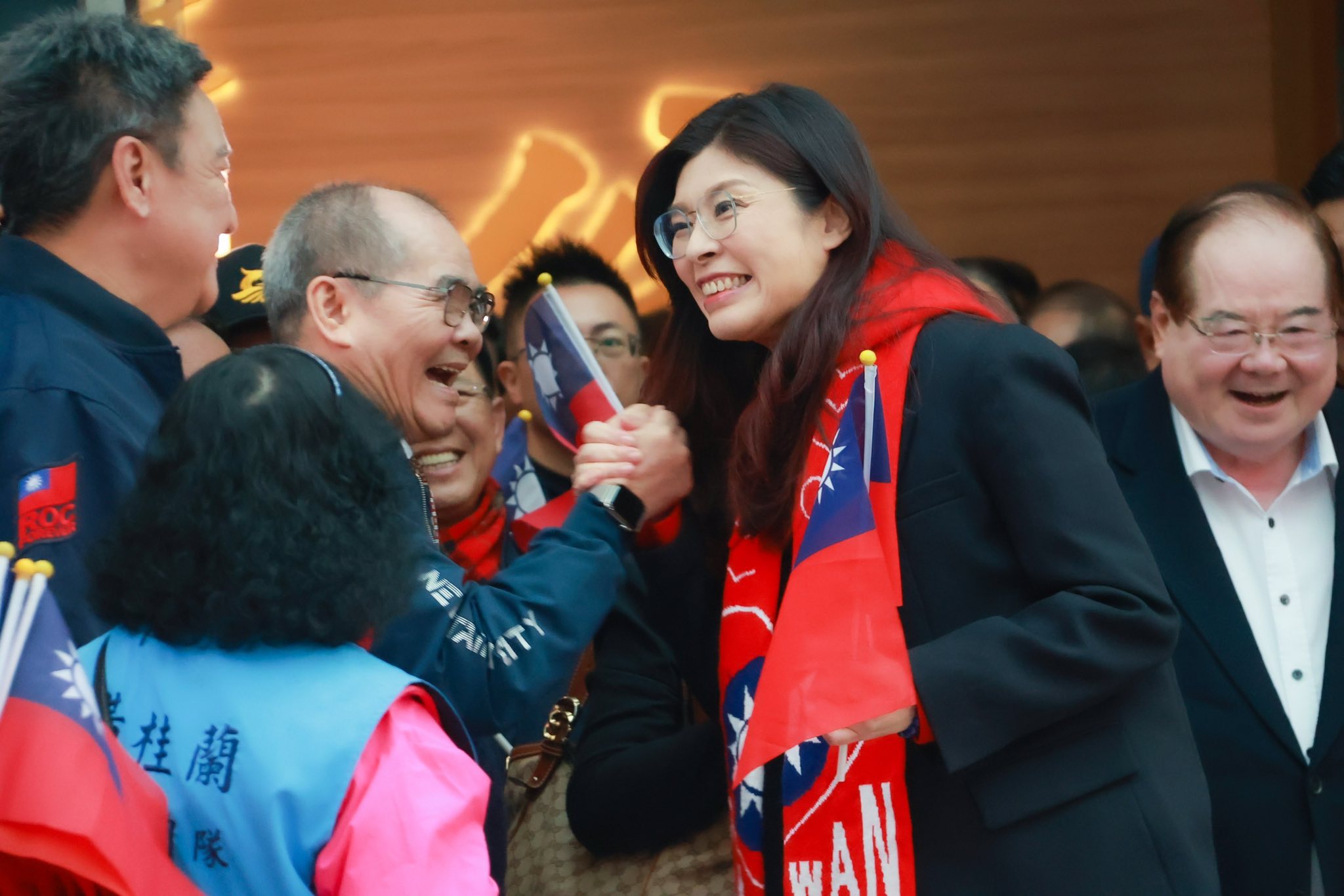
台灣最近的一項民調顯示,超過六成的台灣民眾不希望看到兩岸發生任何戰爭或衝突。
此外,國民黨立委陳玉珍於2025年提議修改《離島建設條例》,將金門和媽祖設立為自由貿易示範區。該修正案旨在吸引和加強內地對金門和媽祖基礎設施及醫療設施的投資。內地學生可以不受名額限制地就讀金門和媽祖的高等院校。
內地企業也可以將內地員工帶到離島工作。這些修正案遭到民進黨立委的強烈批評,他們認為這些修正案對台灣構成經濟、安全和軍事威脅。國民黨立委支持加強兩岸社會經濟聯繫,而民進黨立委則反對此類舉措,雙方的拉鋸戰一直是台灣兩岸政治的標誌性特徵。
儘管台灣政局動盪,但值得注意的是,台灣民眾赴福建省旅遊的人數卻增加。
2025年,福建省批准了30萬份台灣同志赴福建的申請,比前一年增加了22%。在這些赴福建的台灣遊客中,72%的人年齡在45歲以下,顯示許多年輕人對造訪福建表現出濃厚的興趣。單在2025年,台灣民眾往返福建的次數就達到了143萬次。
如此頻繁的訪問表明,儘管兩岸高層政治關係時有波動,但務實態度在兩岸關係基層仍然佔據主導地位。
國民黨主席鄭麗文冀今年訪華
鄭麗文近期在2025年11月國民黨主席選舉中獲勝,為國民黨與中共關係升溫打開了大門。有報導稱,鄭麗文希望在2026年與習近平主席會面,並計劃訪問大陸。
然而,她訪問的時機在政治上至關重要。如果美國總統特朗普很可能在2026年3月底或4月初在北京與習近平主席會晤,那麼鄭麗文的訪台時間可能會被推遲,尤其是在中國大陸可能再次與特朗普討論台灣問題,並提醒美國在民進黨領導下向台灣提供和出售武器是不合適的情況下。
王滬寧就台灣問題發表的最重要講話,是他在2月9日至10日舉行的全國台務工作會議上提出的15點方針。王滬寧表示,大陸和台灣應在推動兩岸關係發展中掌握領導權和主動權,雙方都應堅持「九二共識」。
此外,大陸將團結台灣同志;支持島內愛國力量;堅決打擊台獨勢力;反對外部干涉;維護台灣和平穩定;堅持兩岸一家的理念;促進兩岸人際交往;擴大兩岸基層交流;支持台灣民眾和青年到大陸學習、工作和生活;弘揚兩岸文化和同舟共濟的精神;支持台灣民眾和青年到大陸學習、工作和生活;弘揚兩岸文化和同舟共濟的精神;支持台灣企業在大陸發展;並讓雙方同志享受中國式現代化帶來的機會與成果。
美加緊對台軍售 觸動大陸神經
儘管中共與國民黨之間的互動日益密切友好,但美國的對台政策仍引起了中國大陸領導層的關注。美國國務院繼續計劃向台灣出售武器,而台灣貿易代表團已就美國對台灣商品加徵的關稅達成共識。
此外,美國還在沖繩附近與日本舉行了聯合軍事演習,此舉似乎暗示美日將採取聯合軍事行動,以保護台灣免受其所認為的中國軍事威脅。
美國眾議院最近通過的《保護台灣法案》規定,如果中國的行為對台灣的安全和經濟體系構成「任何威脅」,並且「危及美國利益」,那麼中國代表將被排除參加二十國集團、國際清算銀行、金融穩定理事會、巴塞爾銀行監管委員會、國際保險監督官協會和國際證券委員會組織。
美國在兩岸關係僵局中扮演着至關重要的角色,而且這種角色還會持續下去。
若特朗普賣台 或有突破發展
如果特朗普對台灣問題採取交易策略,中美兩國能否就台灣的政治未來達成任何突破性共識,仍有待觀察。否則,美國將繼續奉行其傳統的戰略模糊策略:一方面奉行一個中國政策,另一方面向台灣提供武器以進行威懾。然而,這種平衡策略正面臨來自中國的巨大壓力,要求改變策略,並加速兩岸整合進程。
目前的僵局未必是壞事,只要台海兩岸不發生軍事意外或衝突,雙方就能和平共處,維持有限的人員和社會經濟往來。然而,一旦發生軍事意外,大陸和台灣雙方將如何巧妙冷靜地應對危機,仍有待觀察。
總之,只要民進黨繼續執掌台灣島的總統職位,兩岸關係的僵局就注定會持續下去。只要民進黨繼續執掌台灣島的總統職位,兩岸關係的僵局就注定會持續下去。為了破局,中國對台採取強硬的軍事姿態與溫和的言論,這種恩威並施的策略將成為兩岸關係發展的新常態。
Cross-strait development: dialectical trend and future prospects
Beijing's approach to Taiwan balances soft-line gestures emphasising peaceful reunification with hard-line military demonstrations, creating a new normal in cross-strait relations
Despite political tensions and US involvement, grassroots socio-economic interactions, cross-strait visits, and limited cooperation continue, highlighting pragmatism on both sides
Recent developments in cross-strait relations have pointed to an interesting dialectical trend with important implications for the future development of Beijing's policies toward the island province of Taiwan.
The most interesting dialectical trend of Beijing-Taipei relations throughout 2025 and in early 2026 was the parallel development of the military exercises conducted by the Chinese Mainland on 1–2 April and 29–30 December, and the soft-line gestures expressed by mainland officials responsible for Taiwan affairs.
The Strait Thunder mission conducted in April 2025 appeared to showcase how the Chinese People's Liberation Army (PLA) could target Taiwan's political heartland, its key harbour, ports and energy supply bases. The Justice Mission conducted in December shifted to demonstrate the PLA's capability of imposing an aerial and a naval blockade of the island of Taiwan.
These two military exercises, however, were accompanied by crucial remarks made by top mainland Chinese officials on Beijing's policies toward Taiwan.
Wang Huning, the Politburo Standing Committee member who deals with Taiwan affairs, said in October 2025 that there would be “seven benefits” of the mainland's reunification with Taiwan: Taiwan would develop its economy; its energy resources would be protected; its basic facilities and structures would be retained; its safety would be maintained; its external relations would be tolerated; the livelihood and well-being of the Taiwan comrades would be safeguarded; and the spiritual and cultural life of the Taiwan people would be enriched (Liberty Times, 26 October 2025).
Wang made his remarks during an annual convention on the 80th anniversary of the mainland's recovery of Taiwan. As the top mainland architect on Taiwan affairs, his comments on the seven benefits to Taiwan represented an important message alongside the two military exercises in April and December 2025. Taking the soft-line remarks and hard-line gestures together, the Chinese Mainland has been adopting a two-pronged strategy toward Taiwan: an emphasis on the immense benefits of peaceful reunification but a clear showcase of the military capability to “take back” Taiwan if necessary.
This two-pronged strategy was shown just one day after Chiang Wan-on, the KMT Taipei Mayor, had visited Shanghai for the Twin City Forum. Another political message was demonstrated: while the KMT was and is the target of the mainland's united front work and friendship policy, the hard-line military gestures aimed at the separatist leaders on the island province of Taiwan.
KMT-CPC engagements and grassroots pragmatism
The beginning of 2026 has been marked by, firstly, the visit of Kuomintang (KMT) vice-chairman Hsiao Hsu-tsen to Beijing to attend a think-tank forum between the KMT and the Communist Party of China (CPC) from 2 to 4 February and by, secondly, the soft-line gestures made by Chinese officials, notably Song Tao and again Wang Huning, over Taiwan. The forum was originally launched by the Chinese President Hu Jintao and the KMT Chair Lien Chan in 2005, but its meetings were terminated in 2016 once Tsai Ing-wen of the Democratic Progressive Party (DPP) grasped power in Taiwan's presidential elections.
Song Tao, the head of both the Taiwan Work Office of the CPC Central Committee and the State Council's Taiwan Affairs Office, said on 4 February 2026 that the two parties should remain unwavering in upholding the political basis of the 1992 consensus, opposing “Taiwan independence,” and jointly guiding the path of cross-strait development toward the “correct” direction (Global Times, 4 February 2026). Song added that firm actions would be taken against the “diehard separatists and their accomplices” in Taiwan, and that external forces' attempt at using Taiwan to “contain China” would not be tolerated.
Hsiao Hsu-tsen also met Wang Huning in Beijing, telling the latter that the Taiwan people do not want to see any cross-strait conflicts, that they want peace, and that he hoped the mainland side would listen to Taiwan's mainstream views.
On the other hand, Wang Huning told Hsiao that both the CPC and KMT must insist on the 1992 consensus (namely, there is only one China, but its meaning is up to the interpretation of the two parties concerned), the opposition to “Taiwan independence,” and the enhancement of the mainland's interactions with Taiwan (Now TV, 4 February 2026). Wang added that the mainland would take care of the interests of the comrades from both sides of the Taiwan Strait, promoting peace, development, exchange and cooperation. Interestingly, the mainland tourism authorities announced quickly that the people in Shanghai would be allowed to visit Taiwan – an immediate and friendly gesture made by the mainland to the Taiwan side.
In response to Wang's remarks, Hsiao said that de-Sinification in Taiwan cannot and will not be successful because “the Chinese consciousness is embedded in our spirit, because the Chinese culture is our entity, and because the Chinese nation is our root” (Now TV, 4 February 2026). Ideologically, the KMT leadership is now sharing much in common with the CPC counterpart.
The KMT-CPC think-tank forum tended to focus on matters of low politics, including the issues of disaster management, climate change and energy development. One Taiwan comment on Wang Huning's remarks was that he appeared to soften his tone a bit and that he changed from emphasising the inevitability of reunification to the maintenance of cross-strait peace and stability, and from the expansion in cross-strait human interactions to the facilitation of cross-strait contacts and civilian exchanges (Newtalk, 11 February 2026).
A recent public opinion poll in Taiwan showed that over sixty per cent of the Taiwan people do not want to see any war or conflicts between the mainland and the Taiwan side – a mainstream view that was mentioned by Hsiao Hsu-tsen.
Furthermore, a KMT legislator, Chen Yu-jen, proposed in 2025 to amend the Offshore Islands Development Act to make Kinmen and Mazu free trade demonstration zones. The amendments aimed at attracting and enhancing the mainland's investment in the infrastructure and healthcare facilities of Kinmen and Mazu. Mainland students would be welcome to study at the tertiary institutions of Kinmen and Mazu without quota restrictions. Mainland companies would be allowed to bring mainland workers to work in the offshore islands. These amendments have been severely criticised by the DPP legislators as posing an “economic,” “security” and “military” threat to Taiwan. The tug-of-war between the KMT, whose legislators favour closer cross-strait socio-economic relations, and the DPP, whose legislators oppose such moves, remains the hallmark of Taiwan's domestic politics on cross-strait interactions.
Despite these fierce political struggles in Taiwan, it is interesting to note that the number of Taiwan people visiting the province of Fujian has increased. In 2025, Fujian province approved 300,000 applications that allowed the Taiwan comrades to visit Fujian – an increase of twenty-two per cent from the previous year (Jornal San Wa Ou, 9 January 2026). Among the Taiwan visitors to Fujian, seventy-two per cent were under 45 years old – a signal that many young people were interested in visiting Fujian. In 2025 alone, the people of Taiwan went in and out of Fujian 1.43 million times. The intensity of such visits indicated that pragmatism prevailed at the grassroots level in cross-strait relations, despite the oscillating relations between the two sides at the top level of the political leadership.
US involvement and ongoing stalemate
The recent victory of Cheng Li-wun in the election of the KMT chairperson in November 2025 has opened the door for a warming of KMT-CPC relations. There were reports saying that Cheng would visit the mainland amid her wish to meet President Xi Jinping in 2026. Nevertheless, the timing of her visit would be politically crucial. If US President Donald Trump will very likely meet President Xi in Beijing in late March or early April 2026, then Cheng's visit to the mainland would likely be arranged at a politically later date, especially if the Chinese Mainland will likely discuss the Taiwan issue with President Trump again and if it will remind the US of the undesirability of providing and selling weapons to Taiwan under the DPP leadership.
The most significant remarks made by Wang Huning on Taiwan were his 15-point formula during the 9–10 February National Meeting on Taiwan Work (Ming Pao, 11 February 2026). Wang said that the Mainland and Taiwan should grasp the leadership and initiatives in fostering cross-strait relations and that both sides should insist on the 1992 consensus. Moreover, the mainland will unify the Taiwan comrades; support the island's patriotic forces; resolutely attack Taiwan's separatist forces; oppose external intervention; maintain Taiwan's peace and stability; uphold the idea of the same cross-strait family; facilitate cross-strait human interactions; expand cross-strait grassroots-level exchanges; support the Taiwan people and youth to study, work and reside in the Chinese Mainland; promote the cross-strait culture and spirit of alignment; support Taiwan business and enterprises to develop in the Chinese Mainland; improve the policy measures on Taiwan enterprises; deepen cross-strait integration; and allow comrades from both sides to enjoy the opportunities and fruits of the Chinese-style modernisation (Ming Pao, 11 February 2026).
Despite the closer and warmer interactions between the CPC and KMT sides, US policy toward Taiwan has raised the eyebrows of the mainland Chinese leadership. The US State Department has continued to plan for the sale of weapons to Taiwan, while a Taiwan trade delegation to the US has already reached a mutual agreement on the US tariffs imposed on Taiwan products. The US also conducted a joint military exercise with Japan near Okinawa – an action that appeared to imply joint US-Japan military moves to “guard” Taiwan against the perceived Chinese military threat. The Protect Taiwan Act that has recently been passed by the US House of Representatives says that, if China's action poses “any threat” to Taiwan's security and economic system and if it “endangers US interests,” then the Chinese representatives would be “excluded” from participation in G20, the Bank for International Settlements, the Financial Stability Board, the Basel Committee on Banking Supervision, the International Association of Insurance Supervisors, and the International Organization of Securities Commissions (See: H.R.1531 – 119th Congress (2025–2026): PROTECT Taiwan Act | Congress.gov | Library of Congress).
Judging from the recent trends in cross-strait relations, the tug-of-war between the mainland and Taiwan will persist. This tug-of-war scenario is characterised by constant KMT-CPC interactions on the one hand, and military exercises occasionally conducted by the PLA near the island province of Taiwan on the other hand.
Stalemate and future prospects
The role of the US is and will be critical in the stalemate in cross-strait relations. If President Trump adopts a transactional approach to dealing with the Taiwan issue, it remains to be seen how China and the US will come up with any breakthrough consensus on Taiwan's political future. If not, the US will continue to adopt its traditional strategic ambiguity: adopting its one-China policy on the one hand but supplying weapons to Taiwan as deterrence on the other hand. This balancing act, however, is under tremendous pressure from China to change in favour of a faster process of cross-strait integration. Perhaps a stage-by-stage process of integration will be a win-win situation to all stakeholders, like the experimentation of closer socio-economic integration between Kinmen and Mazu on the one hand and Fujian province on the other. This path of development, however, is so far blocked by the DPP leadership.
The current stalemate is not necessarily a bad scenario in the sense that as long as military accidents or conflicts do not erupt across the Taiwan Strait, both sides are coexisting peacefully with a limited degree of human and socio-economic interactions. However, if any military accident occurs, it remains to be seen how the mainland and Taiwan side would manage such a crisis skilfully and calmly.
In conclusion, the stalemate in cross-strait relations is destined to persist as long as the DPP is in presidential power on the island province of Taiwan. The dialectical mixture of hard-line military gestures and soft-line remarks made by top Chinese officials responsible for Taiwan affairs is a new normal in the development of cross-strait relations. As long as military accidents do not occur, the current stalemate in cross-strait relations will persist and it is characterised by the constant KMT-CPC interactions, the occasional military exercises conducted by China, the tense relations between the CPC authorities and DPP leadership, the continuous but difficult dialogue between China and the US over the question of Taiwan's future, and a limited degree of socio-economic interactions between the mainland and the people of Taiwan.
原刊於澳門新聞通訊社(MNA)網站,本社獲作者授權轉載。(原文按此)